

Most adults in Europe have suboptimal EPA and DHA levels despite healthy lifestyles.
Supplementing omega-3 can significantly lower mortality risk and slow cellular aging markers.
Testing Omega-3 Index and combining high-quality supplements with lifestyle factors optimizes longevity benefits.
Even if you eat well, exercise regularly, and track your health closely, your omega-3 status may still be quietly working against your longevity goals. Most health-conscious adults in Europe fall short of optimal EPA and DHA levels, not because they ignore nutrition, but because the gap between dietary intake and what the body actually needs is wider than most guides admit. The science linking omega-3 to longer life is no longer emerging — it is robust, specific, and increasingly hard to ignore. This article cuts through the noise to give you a clear, evidence-based picture of why supplementing omega-3 matters, who benefits most, and how to do it right.
Table of Contents
- The science behind omega-3 and longevity
- Omega-3 mechanisms: How do supplements impact your health?
- Who should supplement? Deficiency, diet, and special situations
- Risks, controversies, and best practices for omega-3 supplementation
- Our perspective: What most omega-3 guides overlook
- Next steps: Take control of your omega-3 and longevity
- Frequently asked questions
Key Takeaways
| Point | Details |
|---|---|
| Longevity benefit | Higher omega-3 status is linked to lower mortality and can add several years to life expectancy. |
| Mechanisms and synergy | Omega-3 acts through anti-inflammatory, heart, and metabolic pathways, with greater effects when paired with vitamin D and exercise. |
| Individual needs | Most people in Europe benefit from supplementation due to low dietary intake, but testing and monitoring optimize safety and results. |
| Risks and best practices | Supplement quality, dose, and personal health status must be considered to minimize risks and maximize rewards. |
The science behind omega-3 and longevity
EPA (eicosapentaenoic acid) and DHA (docosahexaenoic acid) are the two long-chain omega-3 fatty acids your body uses most actively. They are structural components of cell membranes, regulators of inflammation, and key players in cardiovascular and brain function. Your body cannot synthesize them efficiently on its own, which means what you eat or supplement directly shapes your biological status.
The longevity data here is striking. Higher blood levels of EPA and DHA are associated with 15 to 21% lower all-cause mortality and 4 to 5 additional years of life in large cohort studies. That is not a marginal benefit. That is a magnitude comparable to quitting smoking or maintaining a healthy weight.
“The Omega-3 Index, a measure of EPA and DHA in red blood cell membranes, is emerging as one of the most clinically relevant biomarkers for longevity and cardiovascular risk.”
What makes this especially relevant is that the strongest benefits appear in people who raise their Omega-3 Index from low to optimal, not just those starting from a place of severe deficiency. Even health-conscious adults with decent diets often sit below the target range of 8%. Biological aging research now shows that omega-3 supplementation can measurably slow cellular aging markers, including telomere length and epigenetic clocks.
Here is a summary of key findings:
| Study focus | Key finding | Population |
|---|---|---|
| All-cause mortality | 15-21% lower risk at high omega-3 index | General adults |
| Lifespan extension | 4-5 additional years associated | Cohort studies |
| Cellular aging | Slowed biological aging markers | Supplemented adults |
| Cardiovascular events | Reduced major cardiac events | High-risk groups |
For anyone serious about longevity expert insights and applying them practically, omega-3 status belongs on your radar alongside sleep, exercise, and metabolic health. It is one of the few modifiable biomarkers with this level of evidence behind it. If you are working through an aging gracefully guide, omega-3 optimization deserves a prominent place in that framework.
Omega-3 mechanisms: How do supplements impact your health?
With an understanding of omega-3’s big-picture impact, let’s look at the underlying mechanisms driving these benefits. Omega-3s do not work through a single pathway. They act like a multi-tool for your biology, touching inflammation, heart function, brain aging, and metabolic regulation all at once.
Here are the core mechanisms at work:
- Anti-inflammatory action: EPA and DHA are precursors to resolvins and protectins, specialized molecules that actively resolve inflammation rather than just suppressing it. Chronic low-grade inflammation is a root driver of aging, and omega-3s directly counter it.
- Cardiovascular protection: Lipid profile management research confirms that omega-3s lower triglycerides, improve arterial flexibility, and reduce platelet aggregation, all of which protect the heart over decades.
- Brain aging: DHA is the dominant structural fat in the brain. Adequate DHA status supports neuronal membrane integrity, neurotransmitter signaling, and protection against cognitive decline.
- Metabolic regulation: Omega-3s improve insulin sensitivity, support healthy adipokine signaling, and help regulate fat storage and energy metabolism.
- Cellular aging: Omega-3 mechanisms include slowing telomere shortening and modulating epigenetic markers associated with biological age.
Why does supplementation matter if you already eat some fish? Because the dose-response relationship is real. Most Europeans eating fish once or twice a week still land below the optimal Omega-3 Index. Supplements reliably raise blood levels in a way that dietary adjustments alone often cannot, especially for older adults whose absorption efficiency declines with age.
For a truly holistic aging guide, omega-3 does not operate in isolation. It works synergistically with other lifestyle pillars.
Pro Tip: Combine your omega-3 supplement with vitamin D and regular resistance exercise. Vitamin D and omega-3 share anti-inflammatory pathways, and exercise amplifies the cardiovascular and metabolic benefits. This trio is one of the most evidence-backed combinations for healthy aging.
Who should supplement? Deficiency, diet, and special situations
Knowing omega-3’s health mechanisms, the next step is figuring out if you personally should consider a supplement. The honest answer is that most adults in Europe would benefit, but the degree of benefit varies significantly based on your diet, age, and health profile.
Here is how to assess your personal need:
- Check your fish intake. If you eat fatty fish like salmon, mackerel, or sardines fewer than two to three times per week, your dietary EPA and DHA is almost certainly insufficient.
- Consider your age. Older adults absorb and convert omega-3s less efficiently. After 50, the gap between intake and need widens.
- Evaluate cardiovascular risk. Those with elevated triglycerides, hypertension, or a family history of heart disease have the most to gain from optimizing omega-3 status.
- Test your Omega-3 Index. This is the most direct way to know where you stand. An omega-3 DNA test can also reveal genetic variants that affect how efficiently you metabolize these fatty acids.
- Monitor after starting. Retest after three to four months of supplementation to confirm your levels have reached the target range.
For most EU adults with low fatty fish consumption, supplementing to reach an Omega-3 Index of 8% via 1 to 2 grams of EPA and DHA daily is the evidence-based target. High doses can raise LDL in some individuals, so monitoring lipids is smart practice.

| Source | Pros | Cons | Absorption |
|---|---|---|---|
| Fatty fish | Whole food matrix, protein | Cost, contaminants, frequency | High |
| Fish oil capsules | Convenient, measurable dose | Quality varies, oxidation risk | Moderate to high |
| rTG form supplements | Superior bioavailability | Higher cost | Highest |
| Algae-based omega-3 | Vegan, sustainable | Lower EPA content | Moderate |
For practical longevity routines tips, building omega-3 optimization into your daily stack is one of the highest-return habits available. The heart risk nuances around supplementation are real but manageable with the right approach.
Pro Tip: When choosing a supplement, look for the re-esterified triglyceride (rTG) form. It is absorbed up to 70% better than standard ethyl ester fish oil. Also check for third-party purity certification to avoid oxidized or contaminated products.
Risks, controversies, and best practices for omega-3 supplementation
Even as omega-3 supplementation becomes more popular, it is vital to understand and navigate the potential risks and controversies. The science is not uniformly positive, and a balanced view protects you from both over-supplementing and under-supplementing.
The most discussed concern is cardiac arrhythmia. Supplements may increase AF and stroke risk by 5 to 13% in healthy individuals without existing cardiovascular disease, particularly at high doses above 3 grams per day. This does not apply equally to everyone, but it is a real signal worth taking seriously.
Key risks and controversies to know:
- Atrial fibrillation risk: Most pronounced at pharmacological doses (3 to 4g/day) in people without CVD. Standard longevity doses of 1 to 2g/day carry a much lower signal.
- Quality variability: Many fish oil products on the market are oxidized before you even open them. Rancid omega-3 may do more harm than good by introducing oxidative stress.
- LDL elevation: High-dose EPA and DHA can raise LDL-C in some individuals, especially those with metabolic dysfunction. Periodic lipid testing is wise.
- Drug interactions: Omega-3s have mild blood-thinning effects. If you take anticoagulants, discuss supplementation with your doctor.
“Current guidelines recommend prioritizing dietary omega-3 from fatty fish for the general population, reserving high-dose supplements for specific clinical indications under medical supervision.”
The omega-3 index evidence supports a targeted approach: get tested, supplement to reach the optimal range, and retest to confirm. This is far more effective than guessing your way through dosing. For anti-aging nutrition tips that are genuinely evidence-based, omega-3 fits best within a balanced diet longevity framework rather than as a standalone fix.
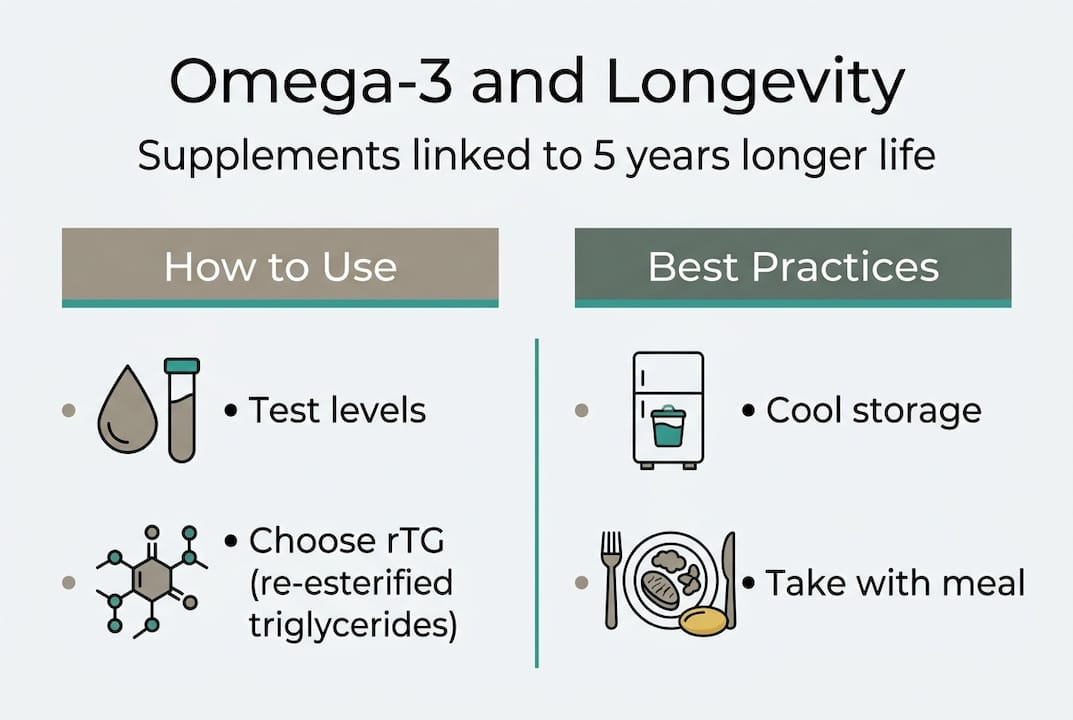
Best practices in brief: choose rTG form, store supplements in a cool dark place, take with a fat-containing meal, and test your Omega-3 Index every six months when actively optimizing.
Our perspective: What most omega-3 guides overlook
Most omega-3 content falls into one of two traps: either it oversells supplements as a universal fix, or it dismisses them as unnecessary if you eat reasonably well. Both miss the point entirely.
The real story is that omega-3 needs are deeply individual. Your genetics influence how efficiently you convert and utilize EPA and DHA. Your baseline diet, your age, your inflammatory load, and your specific health goals all shape what optimal supplementation looks like for you. A blanket “take 1 gram daily” recommendation is better than nothing, but it is not precision health.
What we consistently see is that people who test their Omega-3 Index, adjust their dose accordingly, and retest after three months get meaningfully better results than those who supplement blindly. The anti-aging obsession review culture sometimes pushes people toward more supplements, not smarter ones. The evidence points clearly toward a food-first foundation with targeted, monitored supplementation layered on top. That combination is where the real longevity advantage lives.
Next steps: Take control of your omega-3 and longevity
To act on the information above and make the most of omega-3’s potential, consider these next steps. The science is clear: knowing your omega-3 status is more powerful than guessing at a dose.

Start by testing your omega-3 levels with a home DNA or blood test to understand your personal baseline and genetic factors. From there, explore our longevity kits designed to give you a full picture of your health markers in one place. When you are ready to supplement with confidence, our premium omega-3 supplement MINDBOSS is formulated for maximum bioavailability and purity. At LifeUnlocked, we believe longevity is built on data, not guesswork. Take the first step today.
Frequently asked questions
How much omega-3 should I supplement daily for longevity?
Most experts recommend 1 to 2 grams of EPA and DHA daily in the rTG form to reach an Omega-3 Index of 8%, the target associated with longevity benefits. Always confirm with testing rather than assuming a fixed dose works for your biology.
Is it better to get omega-3 from food or supplements?
Fatty fish are the preferred source because they deliver omega-3 within a whole-food matrix that supports absorption. Quality supplements are a practical and effective alternative for those who cannot meet needs through diet alone.
Are there risks to omega-3 supplements?
High doses above 3 grams per day may increase AF and stroke risk by 5 to 13% in healthy people without heart disease. Standard longevity doses of 1 to 2 grams carry a much lower risk profile when product quality is verified.
How quickly do omega-3 supplements impact health?
Blood omega-3 levels typically respond within four to eight weeks of consistent supplementation. Cognitive improvements, including attention and global cognition, have been observed within months at doses around 2000mg per day.
Can I combine omega-3 supplements with other longevity strategies?
Absolutely. Combining omega-3 with vitamin D and regular exercise is additive for biological aging outcomes. This combination targets multiple aging pathways simultaneously and is one of the most well-supported longevity stacks available.
Share:
Active longevity: holistic solutions for thriving well-being
Optimize vitamin levels for longevity: 40% are deficient