

You eat well, exercise regularly, and still feel off. Sound familiar? 60% of Central Europeans have vitamin D levels below 20 ng/mL, a threshold most experts consider deficient, yet most of them have no idea. A balanced diet is a great foundation, but it cannot tell you what is actually circulating in your blood. Tracking your vitamin levels is the missing link between eating healthy and living optimally. This guide breaks down why biomarker testing matters, who needs it most, and how to use the results to protect your healthspan for the long run.
Table of Contents
- Hidden hunger: The limitations of diet alone
- The science of vitamin biomarker testing
- Optimal versus deficient: What the numbers really mean
- When to track: At-risk groups and common scenarios
- Debate on routine testing: Evidence, supplementation, and expert views
- Applying vitamin tracking: Practical tips for longevity and wellbeing
- Connect your wellness journey with LifeUnlocked
- Frequently asked questions
Key Takeaways
| Point | Details |
|---|---|
| Diet isn’t enough | Even a balanced diet can leave you with hidden vitamin deficiencies, so tracking levels is important. |
| Blood testing reveals health | Biomarker tests are the gold standard for finding out if your vitamin levels support long-term wellbeing. |
| Aim for optimal ranges | Staying above minimum levels and in optimal ranges can lower disease risks and boost longevity. |
| At-risk groups need tracking | If you’re pregnant, elderly, have low sun exposure or special diets, test regularly to stay healthy. |
| Smart supplementation works | Low-dose vitamin D and B supplements are often safe and effective without extensive testing for most. |
Hidden hunger: The limitations of diet alone
Most people assume that eating a varied diet covers all their micronutrient needs. The reality is more complicated. Absorption is not guaranteed. Your gut, your medications, your stress levels, and even your age all influence how much of a vitamin you actually absorb versus how much you simply consume.
This gap between intake and absorption is what researchers call hidden hunger. You can eat plenty of vitamin-rich foods and still run low on critical nutrients. Biomarker tracking goes beyond diet records to reveal what your body is actually working with, preventing deficiency-related issues before they become serious.
Several factors quietly drain your vitamin reserves without obvious symptoms:
- Medications like metformin, proton pump inhibitors, and statins deplete B12, magnesium, and CoQ10
- Chronic inflammation reduces the bioavailability of fat-soluble vitamins like D, A, E, and K
- Aging reduces stomach acid production, which impairs B12 absorption significantly
- Low sun exposure during Northern and Central European winters makes dietary vitamin D nearly impossible to compensate for
A nutrition profile self-test can reveal these gaps quickly and accurately. And if you want to understand how micronutrient status connects to longevity, the link between a balanced diet and longevity is well established but only works when your body is actually absorbing what you eat.
“You cannot manage what you cannot measure. Vitamin tracking turns guesswork into a personalized health strategy.”
The science of vitamin biomarker testing
Biomarkers are measurable indicators in your blood that reflect your body’s actual vitamin status. They are the gold standard for understanding micronutrient health, far more reliable than food diaries or symptom checklists.
Blood serum 25(OH)D for vitamin D and holotranscobalamin for B12 are the most clinically validated markers. Labs adjust results for fasting status, medications, and assay variability to give you an accurate picture. Here is a quick overview of the most commonly tested vitamins and their biomarkers:

| Vitamin | Biomarker tested | Standard unit |
|---|---|---|
| Vitamin D | Serum 25(OH)D | nmol/L or ng/mL |
| Vitamin B12 | Holotranscobalamin | pmol/L |
| Folate (B9) | Red cell folate | nmol/L |
| Iron | Serum ferritin | µg/L |
| Magnesium | Serum magnesium | mmol/L |
Testing methods vary. Venipuncture (a standard blood draw) is the most accurate. Capillary testing (a finger-prick sample) is increasingly used in home kits and is validated for many markers. The healthy aging self-test uses this approach to make testing accessible without a clinic visit.
How to get the most from your test:
- Fast for 8 to 12 hours before a blood draw when testing iron or glucose-sensitive markers
- Note all medications and supplements you take, as these affect results
- Test at the same time of year if tracking seasonally (vitamin D fluctuates significantly)
- Use accredited labs or validated home kits for reliable results
- Always interpret results with reference ranges specific to your lab
Pro Tip: The NHS vitamin D guidance provides clear conversion tables between nmol/L and ng/mL. Knowing which unit your lab uses prevents misreading your results entirely.
Optimal versus deficient: What the numbers really mean
There is a critical difference between not deficient and optimal. Most clinical labs flag deficiency, but they rarely tell you whether your levels support peak cognitive function, immune resilience, or long-term cardiovascular health.
Optimal vitamin D levels between 40 and 60 ng/mL are associated with lower risks for cardiovascular disease, cognitive decline, and certain cancers. Low-normal B6, B9, and B12 are linked to metabolic risk even when they fall within the standard reference range. That is the gap between surviving and thriving.
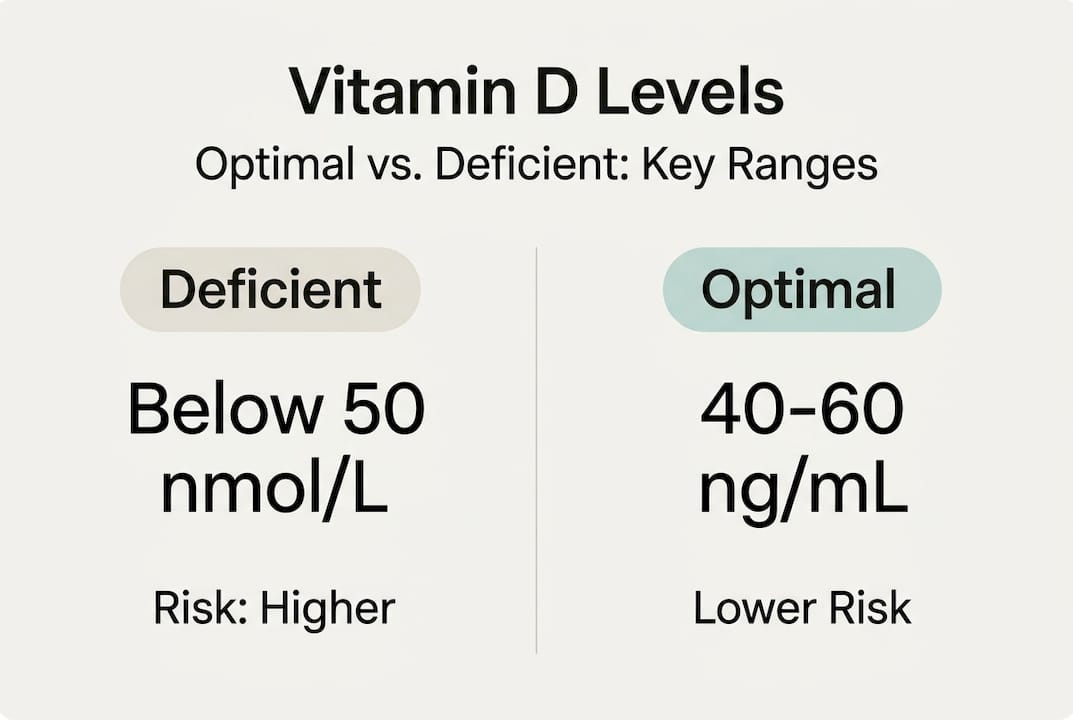
Under EU-aligned clinical guidelines, vitamin D below 50 nmol/L triggers treatment recommendations. But routine screening is not recommended for healthy individuals without risk factors.
| Level | Vitamin D (ng/mL) | Clinical meaning |
|---|---|---|
| Deficient | Below 20 | High risk, treatment needed |
| Insufficient | 20 to 29 | Suboptimal, supplementation advised |
| Sufficient | 30 to 39 | Meets minimum clinical threshold |
| Optimal | 40 to 60 | Associated with best health outcomes |
| Excess | Above 100 | Potential toxicity risk |
Key takeaways from the research:
- 60% of Central Europeans fall below 20 ng/mL, meaning most people are not just insufficient but clinically deficient
- B12 deficiency is common in vegans and older adults but often missed because standard tests measure total B12, not the active fraction
- Magnesium is required for vitamin D activation in the body, making it a critical co-factor often overlooked
Supporting your levels with the right combination matters. Products like magnesium, vitamin D3, and K2 work synergistically. Understanding the vitamin D3 and K2 synergy helps you supplement smarter, not just more. And if skin health and cellular aging are on your radar, the combination of NMN, vitamin D3, and K2 offers compounding benefits worth exploring.
When to track: At-risk groups and common scenarios
Not everyone needs to test every year. But certain life stages and conditions make tracking genuinely important, not optional.
EU guidelines recommend testing for at-risk groups including those with low sun exposure, pregnancy, malabsorption conditions, older age, chronic kidney disease, obesity, and people on specific medications. These are not edge cases. They describe a large portion of the European adult population.
Groups who benefit most from active vitamin tracking:
- Pregnant women need elevated folate, D, and iron; deficiencies carry serious fetal risks
- Vegans and vegetarians are at high risk for B12, iron, zinc, and omega-3 deficiencies
- Adults over 60 absorb B12 and D less efficiently due to reduced stomach acid and skin synthesis
- People with chronic illness including CKD, Crohn’s, or celiac disease face significant malabsorption
- Those on long-term medications like anti-epileptics or metformin need customized tracking
Pregnancy, CKD, obesity, and anti-epileptic medications all require individualized approaches because inflammation and assay variability can distort standard results. A one-size-fits-all reference range simply does not apply.
Pro Tip: If you are generally healthy with no risk factors, empirical supplementation often makes more sense than frequent testing. A performance kit designed for active adults can cover your bases without over-medicalizing your routine.
Common scenarios where testing adds real value:
- Persistent fatigue that does not resolve with rest or diet changes
- Frequent infections or slow wound healing
- Mood changes, brain fog, or unexplained low motivation
- Planning a pregnancy or entering menopause
- Starting a new medication known to deplete micronutrients
Debate on routine testing: Evidence, supplementation, and expert views
Here is where it gets nuanced. Not all experts agree on how often healthy people should test their vitamin levels. The scientific community is genuinely divided.
“Some advocate for optimal ranges; others, including the USPSTF and Endocrine Society, caution against routine testing due to a lack of RCT evidence showing benefits over empirical supplementation.”
Routine vitamin D screening is not recommended for healthy adults by major regulatory bodies. Their argument is straightforward: empirical supplementation at 1000 to 2000 IU daily is safe, inexpensive, and effective for most people without the cost or complexity of regular testing.
The counterargument is equally valid. For longevity-focused individuals, knowing your exact levels allows you to optimize rather than just prevent deficiency. There is a meaningful difference between supplementing blindly and supplementing with precision.
Practical guidance for navigating this debate:
- Follow EFSA and NHS guidance on upper safe limits to avoid over-supplementation
- Use testing strategically, not reflexively. Test when you have a reason, not just because you can
- If you are pursuing longevity optimization, personalized tracking is worth the investment
- Understand that metabolic health and vitamin status are deeply interconnected, making both worth monitoring together
Applying vitamin tracking: Practical tips for longevity and wellbeing
Knowing you should track is one thing. Knowing how to do it well is another. Here is a clear, actionable framework.
Track selectively if at risk; reliable biomarkers and empirical supplementation are often preferred over routine testing for healthy individuals. Use this step-by-step approach:
- Identify your risk profile based on age, diet, sun exposure, medications, and health conditions
- Consult your doctor or a health advisor to select the right biomarkers for your situation
- Choose a validated testing method, whether a clinic blood draw or a home kit like the nutrition profile test
- Interpret results in context, comparing against optimal ranges, not just deficiency cutoffs
- Act on findings by adjusting supplementation, diet, or lifestyle with targeted products from trusted supplement options
- Retest after 3 to 6 months if you have made significant changes to confirm your levels have shifted
Pro Tip: Timing matters. Test vitamin D in late winter (February or March in Europe) to capture your seasonal low point. This gives you the most actionable data for supplementation planning through spring and summer.
Supplement selection tips:
- Choose D3 over D2 for superior bioavailability and longer-lasting effects
- Pair vitamin D with K2 to direct calcium to bones rather than arteries
- Take fat-soluble vitamins (A, D, E, K) with a meal containing healthy fats
- Use methylated forms of B12 (methylcobalamin) and folate (methylfolate) for better absorption
Connect your wellness journey with LifeUnlocked
You now have the knowledge. The next step is making it personal. At LifeUnlocked, we believe that tracking your vitamin levels should be simple, accurate, and actionable, not a clinical ordeal.

Our longevity kits are designed for health-conscious individuals who want more than a generic supplement routine. Whether you start with a nutrition profile self-test to identify your specific gaps or explore our curated supplement options to fill them, every product is built around one goal: helping you live longer and feel better. The KLU app ties it all together, turning your results into a personalized longevity plan that evolves with you.
Frequently asked questions
Who in the EU should track their vitamin levels?
Testing is recommended for at-risk groups including those with low sun exposure, pregnancy, older age, vegan diets, or chronic conditions like kidney disease or malabsorption disorders.
How are vitamin levels usually tracked?
Most commonly, blood tests measure biomarkers like serum 25(OH)D for vitamin D and holotranscobalamin for active B12, both of which reflect what your body is actually using.
Can I supplement vitamin D without testing first?
Empirical supplementation at around 1000 to 2000 IU daily is considered safe and effective for most adults, making it a reasonable starting point even without a prior blood test.
What happens if I ignore vitamin tracking?
You risk hidden deficiencies that quietly affect your metabolism, immune function, and long-term health, even when your diet looks perfectly balanced on paper.
Recommended
- Unlock Your Health Potential: Discover Our Comprehensive DNA Tests – LifeUnlocked
- Unlocking Longevity 2024: Practical Tips and Routines for a Longer, He – LifeUnlocked
- Unleashing the Power of a Balanced Diet: A Decade of Extended Life – LifeUnlocked
- 7 Areas to Start Your Longevity Journey – LifeUnlocked
Aktie:
Keine Lust mehr auf klassisches Fitnessstudio? Probieren Sie Handstände für eine überraschende Steigerung der Lebenserwartung!
Increase vitality: A step-by-step guide to holistic energy